Why Do Some Familys That Lose on Family Fued Return to Play Again
| Family unit Feud | |
|---|---|
 | |
| Genre | Game show |
| Created by | Mark Goodson |
| Directed by |
|
| Presented by |
|
| Narrated by |
|
| Theme music composer |
|
| Country of origin | United States |
| Original linguistic communication | English |
| No. of seasons | 22 |
| No. of episodes | two,311 (ABC Daytime; 1976–1985) 976 (Syndicated; 1977–1985) 17 (ABC Primetime; 1978–1984)[1] [ ameliorate source needed ] |
| Production | |
| Executive producer | Steve Harvey |
| Producers |
|
| Running time |
|
| Production companies |
|
| Benefactor |
|
| Release | |
| Original network |
|
| Movie format |
|
| Audio format |
|
| Original release | July 12, 1976 (1976-07-12) – present |
| Chronology | |
| Related shows |
|
Family Feud is an American television game bear witness created by Marker Goodson featuring two families who compete to proper name the most popular answers to survey questions in society to win cash and prizes.
The testify has had 3 divide runs, the first of which started in 1976. Its original run from 1976 to 1985 aired on ABC and in syndication, with Richard Dawson equally host. In 1988, the series was revived and aired on both CBS and in syndication with Ray Combs hosting until 1994, with Dawson returning until that version ended in 1995. In 1999, the series was revived through its get-go-run syndication with four different hosts: Louie Anderson (1999–2002), Richard Karn (2002–2006), John O'Hurley (2006–2010), and Steve Harvey (2010–present). Studio announcers who introduced the contestants and read credits included Gene Wood (1976–1995), Burton Richardson (1999–2010), Joey Fatone (2010–2015), and Rubin Ervin (2015–present).
Within a year of its debut, the original version became the number i game show in daytime television receiver; still, as viewing habits inverse, the ratings declined. Harvey condign host in 2010 increased Nielsen ratings significantly and eventually placed the program among the height iii most-popular syndicated telly shows in the Us. Harvey has also surpassed every previous host in tenure, although Dawson hosted more episodes of the show.
The program has produced multiple regional adaptations in over 50 international markets outside the United States. Reruns of episodes hosted past Steve Harvey air on Game Bear witness Network, as well as in syndication while reruns of earlier versions air on Buzzr. Aside from television shows, there take been also many home editions produced in lath game, interactive film, and video game formats.
Gameplay [edit]
The game features two competing families, each represented by five members (reduced to four contestants for the 1994–95 season), who compete to determine the answers to survey questions. The original version of the show began with the families beingness introduced, seated opposite each other as if posing for family unit portraits, afterward which the host interviewed them.[2]
The minimum age to participate in Family Feud is xv, although every family must have at least ane person who is 18 years or older. Each round begins with a "face up-off" question that serves every bit a toss-up between 2 opposing contestants. The host asks a survey question that was previously posed to a grouping of 100 people, such as "Name the hour that you lot go up on Dominicus mornings."[3] A sure number of answers are curtained on the board, ranked by popularity of the survey'due south responses. Only answers said by at least 2 people can appear on the board. The first contestant to buzz-in gives an answer; if it is the most popular, his/her family immediately wins the face up-off. Otherwise, the opponent responds and the family member providing the college-ranked answer wins. Ties are broken in favor of the contestant who buzzes in get-go. If neither contestant'southward answer is on the board, the other eight contestants have a adventure to respond, one at a time from alternating sides, until an answer is revealed. The family that wins the face-off may choose to play the question or laissez passer command to their opponents (except on the 1988–95 versions, when the family who won the face-off automatically gained control of the question).[3]
The family unit with control of the question then tries to win the round by guessing all of the remaining concealed answers, with each member giving one respond in sequence. Giving an incorrect answer, or failing to respond, earns a strike. Iii strikes gives their opponents a adventure to "steal" the points for the round by guessing any remaining answers. Otherwise, the points back to the family that originally had control. From 1992 to 2003, the value of the "stealing" answer was credited to the "stealing" family unit. If the opponents are given the opportunity to "steal" the points, then but their team's captain is required to answer the question. For most of the series, this is done after the family unit confers with each other; the simply exception was on the 1988 serial where each family member was polled for an answer with the team captain having the option to either select 1 of the family unit's answers or give a different answer.[3] Whatsoever remaining concealed answers on the board that were not guessed are so revealed.
Answers are worth 1 signal for every person in the 100-fellow member survey who gave them. The winning family in each circular scores the total points for all revealed answers to that question, including those given during the face-off but excluding the i used to steal. The number of answers on the board decreases from round to circular, and every bit the game progresses, certain rounds are played for double or triple point value.[2]
For most of the show's existence, the first squad to achieve or surpass a certain betoken total won the game. The nearly mutual goal has been 300 points but there have been exceptions. When the original series start premiered, the goal was 200 points and for its final yr, it was increased to 400 points.[4] From the debut of the original series until 1992, families were awarded $ane per bespeak scored.
From 1999 to 2003, the family with the highest indicate total subsequently four rounds of play won the game regardless of their score. The first three rounds were played equally normal rounds. In the 4th rounds, the point values were tripled, but the families were only allowed i strike if they had control. In the rare example that the family in control was trailing and could not accumulate enough points to potentially overtake the leaders before striking out, the game ended without the other family attempting to steal.
On the get-go ii serial a lucifer continued until a family reached the goal. The current series reinstated the 300 signal goal in 2003 merely kept the iv round format. If neither family has reached 300 points afterwards four rounds, one more than triple value question is played equally a sudden expiry face-off. But the superlative answer is displayed on the board, and the first contestant to buzz in with it wins the points and the game for their team.
In the original periodic primetime specials, three games were played, with the get-go two using the $200 format. For the third game, simply one question round was played with the winning two glory teams from the previous rounds playing.[5]
Fast Money [edit]
At the end of the main game, the winning family selects two members to play the evidence'south bonus round, known as "Fast Money". 1 contestant is onstage with the host, while the other is sequestered backstage with headphones and so as not to hear or see the offset portion of the round. The beginning contestant is asked five rapid-burn down survey questions and has a set up fourth dimension limit in which to respond them (originally 15 seconds, extended to 20 in 1994); fourth dimension begins to run but after the first question is asked, and the first contestant may pass on a question and return to it after all v accept been asked, if time remains.
Afterward the showtime contestant has finished answering or run out of fourth dimension, he or she is awarded a indicate for each person in the survey who gave the aforementioned response. Once these points are tallied, the board is cleared except for the total score, and the 2nd contestant is then brought out to answer the same v questions. The same rules are followed, but the time limit is extended past 5 seconds (originally 20, and then extended to 25); in improver, if the second contestant duplicates an answer given by the starting time, a buzzer sounds and he or she must give some other answer. The family unit is awarded $5 for each indicate. If the two contestants reach a combined full of 200 points or more, the family wins a cash prize.[3]
The cash prize for winning Fast Money has varied. During the ABC and CBS incarnations of the evidence, the elevation prize was $5,000,[6] [vii] and $x,000 in syndication. In 2001, the prize was doubled to $xx,000.[8]
In the original periodic primetime specials, each game was followed by a Fast Money round. The beginning two were each worth $5,000, and the final one was worth $x,000.[five]
Returning champions [edit]
When Family unit Feud premiered on ABC, network rules dictated how much a family could win. Once whatsoever family reached $25,000, they were retired as champions.[9] [ better source needed ] The accompanying syndicated series that premiered in 1977 featured two new families each episode because of a and so mutual television syndication do known as "bicycling" (wherein individual stations sent an episode of a serial they had already aired to another station, reducing the number of tapes a syndicator had to ship out but as well ensuring that stations did not air the same episode of a show the same twenty-four hours, nor were they bodacious of airing in a proper sequence).
The CBS daytime and syndicated versions which began airing in 1988 also featured returning champions, who could appear for a maximum of five days.[10] [ better source needed ] For a brief catamenia in the 1994–95 flavor which aired in syndication, there were no returning champions. For these episodes, two new families competed in this first half of each episode. The second half featured former champion families who appeared on Family Feud betwixt 1976 and 1985, with the winner of the first half of the testify playing i of these families in the second one-half.[eleven] [ better source needed ]
In some cases from 1992 to 1995, the returning champions continued until they were defeated. From 1999 to 2002, two new families appeared on each episode. In 2002, returning champions again appeared with the aforementioned five-twenty-four hours limit.[12] [ better source needed ] In 2009, a new car was announced for a family who wins v games in a row.
Bullseye/Bankroll game [edit]
In June 1992, the CBS daytime edition of Feud expanded from 30 to 60 minutes and became known equally the Family unit Feud Challenge. Equally part of the modify, a new round was added at the start of each game called "Bullseye". This round determined the potential Fast Money stake for each team.[thirteen] Each team was given a starting value for their bank and attempted to come up with the top answer to a survey question to add to it. The Bullseye round was added to the syndicated edition in September 1992, which remained thirty minutes and was retitled equally the New Family unit Feud.
The first two members of each family appeared at the face up-off podium and were asked a question to which only the number-1 reply was available. Giving the top answer added the value for that question to the family'due south banking company. The process and so repeated with the four remaining members from each family. On the first half of the daytime version, families were staked with $ii,500. The first question was worth $500, with each succeeding question worth $500 more the previous, with the concluding question worth $two,500. This allowed for a potential maximum depository financial institution of $10,000. For the 2d one-half of the daytime version, and also on the syndicated version, all values were doubled, making the maximum potential bank $xx,000. The team that somewhen won the game played for their bank in Fast Money.
In 1994, with Richard Dawson returning as host, the round's name was inverse to the "Bankroll" round.[fourteen] Although the goal remained of giving but the number-one answer, the format was modified to iii questions from five, with only one member of each family participating for all three questions. The initial pale for each family remained the same ($ii,500 in the outset half of the hour and $5,000 in the second). However, the value for each question was $500, $i,500 and $2,500 in the first half, with values doubling for the 2d one-half. This meant a potential maximum bank of $7,000 in the first one-half and $xiv,000 in the second.[14]
The Bullseye round returned for the 2009–2010 season and was played similarly to the format used from 1992 to 1994 on the syndicated version. V questions were asked, worth from $ane,000 to $5,000. However, each family unit was given a $fifteen,000 starting stake, which meant a potential maximum of a $thirty,000 bank.
When Harvey took over as host, the Fast Money jackpot reverted to a apartment $20,000.
Hosts and announcers [edit]
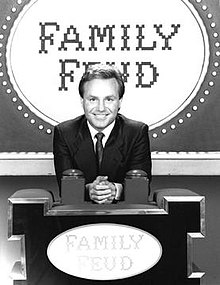
When Family Feud was conceived in 1976, Richard Dawson (then a regular panelist on the Goodson–Todman game testify Match Game) had a continuing agreement with Mark Goodson that when the next Goodson–Todman game show was in the planning stages, Dawson would be given an audience to host it. Dawson had read in trade publications that a airplane pilot for a new show named Family Feud was in the works, and it was originally to be hosted by Star Trek role player William Shatner (although since they were involved in the run-throughs, Geoff Edwards and Jack Narz, the latter of whom reputedly was Goodson'due south initial choice to host, were under consideration). Incensed, Dawson sent his agent to Goodson to threaten to present an un-funny, silent, and banal persona on future Friction match Game episodes if he was not given an audition for Feud.[15] Dawson was and then selected equally host of the original ABC and outset syndicated versions of Family Feud. Every bit writer David Marc put it, Dawson's on-air personality "fell somewhere between the brainless sincerity of Wink Martindale and the raunchy cynicism of Chuck Barris".[16] Dawson showed himself to accept insistent affections for all of the female person members of each family that competed on the show, regardless of age, kissing them, an deed that attracted some controversy then amongst viewers.[16] Writers Tim Brooks, Jon Ellowitz, and Earle F. Marsh attributed Family Feud 's popularity to Dawson'southward "glib familiarity" (he had previously played Newkirk on Hogan'due south Heroes) and "ready wit" (from his tenure as a panelist on Match Game).[2] The evidence's original announcer was Gene Wood,[17] with Johnny Gilbert and Rod Roddy serving equally occasional substitutes.[18]
In 1988, comedian Ray Combs took over Dawson's part as host on CBS and in syndication with Wood returning as announcer and Roddy and Art James serving in that office when Wood was not available.[18] Combs hosted the plan until the daytime version's counterfoil in 1993 and the syndicated version until the finish of the 1993–94 flavor. Dawson returned to the show at the request of Marker Goodson Productions for the 1994–95 season.[nineteen]
When Feud returned to syndication in 1999, it was initially hosted past comedian Louie Anderson,[ii] with Burton Richardson as the new journalist.[xx] In 2002, Richard Karn was selected to take over for Anderson,[2] until he was replaced by John O'Hurley in 2006.[2] In 2010, both O'Hurley and Richardson departed from the show. O'Hurley later stated that he left because he was resistant toward the bear witness'due south decision to emphasize ribald sense of humour and wanted to continue the show family-friendly.[21] Steve Harvey was later named the new host for 2010–11 flavour,[22] and announcements were made using a pre-recorded track of Joey Fatone'due south vox.[23] In 2015, Harvey signed with ABC for the primetime reboot of Celebrity Family Feud, with Burton Richardson returning as announcer. Rubin Ervin, who has been a member of the production staff equally the warmup man for the audition since Harvey took over, became the journalist from 2015–16 flavour.
Production [edit]
The first four versions of the show were directed by Paul Change and produced by Howard Felsher and Cathy Dawson. For the 1988 versions, Gary Dawson worked with the show as a tertiary producer, and Modify was joined by ii other directors, Marc Breslow and Andy Felsher.[18] The 1999 version's primary staff include executive producer Gabrielle Johnston, co-executive producers Kristin Bjorklund, Brian Hawley and Sara Dansby, and director Ken Fuchs; Johnston and Bjorklund previously worked as associate producers of the 1980s version.[24] The show'due south archetype theme melody was written by an uncredited Walt Levinsky for Score Productions. The theme and cues for the 1994–1995 version was written past Edd Kalehoff and are based on the Walt Levinsky composition. The themes used from 1999 to 2008 were written by John Lewis Parker.[24] The product rights to the prove were originally owned by the production company Goodson shared with his partner Pecker Todman, but were sold to their current holder, Fremantle, when it caused all of Goodson and Todman'due south format itemize in 2002.[24]
Circulate history [edit]
1976–1985 [edit]

Richard Dawson (left) and contestants on the pilot episode of Family Feud
Mark Goodson created Family Feud during the increasing popularity of his earlier game prove, Match Game, which had gear up daytime ratings records between 1973 and 1976, and on which Dawson appeared near daily equally one of its virtually popular panelists. Lucifer Game aired on CBS, and past 1976, CBS vice-president Fred Silverman, who had originally deputed Match Game, had moved to a new position as president of ABC. The show, along with a revised daytime schedule for the summer, was first announced by ABC at an annual coming together in May.[25] The evidence premiered on ABC's daytime lineup at i:30 p.m. (ET)/12:30 p.thousand. (CT/MT/PT) on July 12, 1976. Considering it faced the first halves of two long-running and pop soap operas, CBS' As the World Turns and NBC'due south Days of Our Lives, Feud was not an immediate hit. But a timeslot change several months later made it a ratings winner for ABC, and it eventually surpassed Match Game to become the highest-rated game show on daytime Tv.
Due to the expansion of All My Children to one hour in April 1977, the show was moved to xi:thirty/10:30 a.k., equally the second part of an hour that had daytime reruns of Happy Days (afterwards Laverne & Shirley) equally its atomic number 82-in. When the Dick Clark-hosted $20,000 Pyramid was canceled in June 1980, Feud moved a one-half-hr back to 12 noon/xi:00 a.m.[26] It remained the most popular daytime game testify until Merv Griffin's game show Cycle of Fortune, propelled past a new, highly-popular concurrent syndicated evening version, surpassed it in 1984.[3] From May 8, 1978 until May 25, 1984, ABC periodically broadcast hour-long primetime "All-Star Specials", in which celebrity casts from various primetime Boob tube serial (mostly ABC ones) competed instead of ordinary families.[2] The popularity of the program inspired Goodson to consider producing a dark edition, which launched in syndication on September 19, 1977 with Viacom Enterprises as distributor. Like many other game shows at the time, the night Feud aired in one case a week; information technology expanded to twice a week in January 1979,[iii] and finally to five nights a week (Monday through Friday) in the fall of 1980, representing the start fourth dimension that a weekday network game ran concurrently with a nightly syndicated edition. Dawson and Feud coasted for several years at the top, seen twice a day in much of the state. However, the viewing habits of both daytime and syndicated audiences began changing around 1984.[3] When Griffin launched Wheel 's syndicated version, starring Pat Sajak and Vanna White, in 1983, that testify climbed the ratings to the point where it unseated Feud as the highest-rated syndicated testify, even replacing information technology on some stations;[27] the syndicated premiere of Wheel 's sister show Jeopardy! with Alex Trebek equally host likewise siphoned ratings from Feud with its early (and surprising, given an unstable first few months) success. With declining ratings (probably due mainly to its overexposure and viewers subsequently tiring of the show), and as part of a scheduling reshuffle with ii of ABC'south half-hour soaps, the show moved back to the xi:xxx/ten:30 timeslot in Oct 1984, as the 2nd part of a i-hour game bear witness block with Trivia Trap (later on All-Star Blitz) as its lead-in, hoping to make a paring in the ratings of The Price Is Right, coincidentally another Goodson-packaged show.
Despite the ratings reject, there was some involvement in keeping the show in production. In a 2010 interview, Dawson recalled a meeting with executives from Viacom almost renewing the show for one more season afterward 1985. Dawson was growing tired of the grueling taping schedule and initially wanted to stop altogether. After discussing the situation with ABC and Viacom, Dawson said that he would return for a final syndicated season of thirty-nine weeks of episodes but would not go on doing the daytime serial. After this, Dawson did not hear from Viacom for approximately a calendar week and once they contacted him again, Dawson was told that Viacom was no longer interested in standing the syndicated Feud across the 1984–85 season.[28] Viacom made this official in January 1985 ahead of that yr's NATPE convention, and within a few weeks, ABC, probably prompted by Viacom'due south conclusion, decided that information technology too would non renew Feud for the 1985–86 season.[29] The daytime version came to an end on June 14, 1985.[3] The final week was taped a month prior, on May 16. Newspapers via Associated Printing reported that this version was slated to end on June 28. Notwithstanding, for reasons undisclosed, information technology concluded two weeks prior to that instead.[30] The syndicated version aired its last new episode on May 17, 1985, with reruns standing to air until September of that year.[3]
1988–1995 [edit]
Ray Combs in a publicity photo for Family Feud (1988)
Family Feud moved to CBS with Ray Combs hosting the show on July 4, 1988 at ten:00 a.yard. (ET)/nine:00 a.m. (CT/MT/PT), replacing The $25,000 Pyramid (which had aired continuously in that time slot since September 1982, except betwixt January and Apr 1988, when Blackout took its place; CBS began development on Family Feud shortly after Coma was canceled). Like its predecessor, this version as well had an accompanying syndicated edition which launched in September of that year.
The CBS version started off with expert ratings, particularly with women, just struggled to sustain that momentum. The irresolute mural of daytime tv set, with most networks giving more of their available daytime timeslots to syndicated programming, plus the decline of game shows as a genre at the time, began to hurt Feud, and many CBS affiliates dropped the program from their lineups. It moved to 10:30/nine:30 in Jan 1991 to make room for a short-lived talk show starring Barbara De Angelis. At that fourth dimension frame, it replaced the daytime Wheel of Fortune, which moved back to NBC after a ii-year run on CBS hosted by Bob Goen just even so featuring Vanna White.[2]
In June 1992, the network version expanded from its original half-hour format to a total hr, and was retitled The Family Feud Challenge;[2] this new format featured 3 families per episode, which included 2 new families competing in the outset half-hour for the correct to play the returning champions in the 2nd half. Early on into the fifth season, however, CBS announced it would no longer programme the 10:00 a.m. ET timeslot starting in the fall of 1993, effectively cancelling Feud. The Family unit Feud Challenge aired its concluding new episode on March 26, 1993, with reruns airing until September 10 of that yr.[31]
The syndicated Feud, however, remained in product and entered its 6th flavor in the fall of 1993. The evidence, even so, had dealt with a consequent ratings downturn for several years. It initially secured time frames in desirable hours, such as the Prime Fourth dimension Admission hour, merely stations quickly constitute other programming, such every bit A Current Matter, Inside Edition and Hard Copy tended to describe higher ratings, peculiarly among younger, more desirable viewers, and sought these shows to replace Feud. Some stations dropped the evidence, while others relocated it to lower-rated fourth dimension frames such every bit late night and early on morn slots. This resulted in Feud'due south ratings bottoming out in the 1992–93 season and its distributor, All American Television informed Mark Goodson Productions that unless there was an uptick in ratings or changes were made to the program, they'd cancel it at the end of the 1993–94 flavour.
The responsibility for this was all in the hands of Jonathan Goodson, who had taken over his male parent's company when Mark Goodson died in 1992. I of the options considered was a host modify, with original Feud host Richard Dawson's proper name being repeatedly mentioned every bit an option.[nineteen] The consideration of Dawson as host was a reversal of policy, since Mark Goodson had refused to consider Dawson as host for the revival serial and had remained loyal to Combs from the moment he hired him. There were also many staffers from the original series that were working on the revival, including executive producer Howard Felsher with whom Dawson had significant friction with. Equally a issue, there were many lingering bad feelings over Dawson'due south behavior and at that place was relative unease over the idea of him returning to Feud.
Jonathan Goodson felt that a change was necessary in order to go on the show in production, and presently thereafter Goodson contacted Dawson about returning. Dawson, who had largely retired from show business by 1993, agreed to terms on a contract and All-American Television decided to renew the syndicated Feud for at to the lowest degree ane more than year. Combs, who was upset over his firing, finished the remainder of the 1993–94 season as host with his final episodes taping in early 1994. After the last taping session concluded, Combs left the studio without saying adieu to anyone.[19]
A revamped Family Feud returned for a seventh season in September 1994, with Dawson returning as the host. The show expanded from thirty to sixty minutes, reinstated the Family Feud Claiming format, and did various other things to effort to improve ratings such every bit modernizing the set, featuring families that had previously been champions on the original Feud, and having more themed weeks. Although Dawson did bring a brief ratings surge when he came back, the evidence could not sustain information technology long term and Feud came to a conclusion at the end of the season, with Dawson retiring permanently afterward. Its terminal new episode aired on May 26, 1995, with reruns airing until September 8 of that year and repeated failures to come to an understanding with various syndicators kept information technology off the air for most the next four years.
Exterior of the show Ray Combs, whose life was falling apart due to financial ruin caused in large measure out by the typecasting he incurred as host of Feud, never constitute other show-business employment and committed suicide on June 2, 1996 by hanging himself in a Glendale psychiatric ward.
1999–nowadays [edit]


Family Feud returned in syndication on September 20, 1999, with comedian Louie Anderson every bit the next host.[32] 3 years later, Richard Karn took over the show. The format was changed to reintroduce returning champions, allowing them to announced for up to v days.[2] Anderson-hosted episodes connected in reruns that aired on PAX TV/Ion Tv. Karn hosted the show for four years until he was replaced by John O'Hurley in 2006 and Steve Harvey in 2010.
The show'southward Nielsen ratings were at 1.5, putting information technology in danger of cancellation once again (as countless affiliates that carried the bear witness from 1999 to 2010 aired it in daytime, graveyard or other depression-rated fourth dimension slots). Since Steve Harvey took over the prove, ratings increased by as much as forty%,[33] and inside ii short years, the show was rated at four.0, and had become the 5th-most-pop syndicated program.[34] Pull a fast one on News' Paulette Cohn argued that Harvey's "relatability," or "understanding of what the people at home want to know," was what saved the evidence from cancellation;[35] Harvey himself debated, "If someone said an answer that was then ridiculous, I knew that the people at dwelling house behind the camera had to be going, 'What did they merely say?' … They gave this reply that doesn't have a shot in hell of being upwardly there. The fact that I recognize that, that's comedic genius to me. I think that's [what made] the deviation."[35]
Steve Harvey's Family Feud has regularly ranked among the tiptop 10 highest-rated programs in all of daytime television programming and 3rd amongst game shows (behind Bicycle of Fortune and Jeopardy!); in February 2014, the show achieved a 6.0 share in the Nielsen ratings, with approximately 8.viii meg viewers.[36] In June 2015, Family unit Feud eclipsed Wheel of Fortune, which had been on peak for over 30 years, every bit the about-watched syndicated game show on television, and consistently began ranking among the height three shows in all of syndication. The show has had improved syndication clearances and meliorate timeslots. It has been airing in early on fringe and prime number access slots nationwide.[37]
Reruns of the Dawson-, Combs-, Anderson- and Karn-hosted episodes have been included amid Buzzr's acquisitions since its launch on June 1, 2015.[38] In 2019, reruns of the Karn-hosted episodes started airing on Upwards TV during the morning hours.
Product of Family Feud was shifted from Universal Orlando to Harvey's hometown of Atlanta in 2011, outset staged at the Atlanta Borough Center and afterward at the Georgia World Congress Eye. Harvey was also originating a syndicated radio evidence from Atlanta, and the state of Georgia provided tax credits for the production. In 2017, production moved to Los Angeles Center Studios (after moved again to Universal Studios Hollywood and subsequently still to CBS Studio Center) in Los Angeles to accommodate Harvey's new syndicated talk show Steve, returning production of the regular series to Los Angeles for the outset time since 2010.[39] [40] [41] [42]
In Nov 2019, Harvey started production in Due south Africa for that country's version.[43] It aired for the first time on Dominicus, April v, 2020. In conjunction, a website was launched, dedicated to the region to catch up on previous episodes, submit entries and engage from a local perspective.[44]
In March 2020, later on initially announcing that production would go on with no studio audience, Fremantle suspended production of all of its programs (including Family Feud) due to the onset of the COVID-nineteen pandemic. In Baronial 2020, Family Feud returned to production, returning to Atlanta after several years in California and with health and safety protocols (including social distancing and no studio audience) being enforced.[45] [46] [47] Since 2021, the series was filmed at Trilith Studios in Fayetteville, Georgia.[48]
Reception [edit]
Family Feud won the Daytime Emmy Award for Outstanding Game/Audition Participation Prove in 1977 and 2019, Outstanding Directing for a Game Bear witness and the prove has 3 times won the Daytime Emmy for Outstanding Game Testify Host, once with Dawson in 1978 and twice with Harvey in 2014 and 2017.[49] [fifty] Feud ranked number 3 on Game Show Network (GSN)'s 2006 list of the 50 Greatest Game Shows of All Time,[51] and as well on Tv set Guide 's 2013 list of the 60 greatest game shows ever.[52]
Tara Ariano and Sarah D. Bunting, founders of the website Television Without Pity, wrote that they hated the 1999 syndicated version, saying "Requite us classic Feud every fourth dimension", citing both Dawson and Combs equally hosts. Additionally, they called Anderson an "alleged sexual harasser and total-fourth dimension sphere".[53]
Since Harvey became host, the prove has go notorious for questions and responses that are sexual in nature, with content frequently referring to certain anatomy or acts of intercourse.[54] This blazon of material has fatigued criticism from viewers, including former NCIS actress Pauley Perrette, who in 2018 sent a series of tweets to Family Feud producers questioning why the evidence had to be "so filthy."[55] [56] Dan Gainor of the Media Research Center, a politically bourgeois content analysis organization, suggested that the responses are in line with sexual content condign more commonplace on television.[55]
The popularity of Family Feud in the United states of america has led it to go a worldwide franchise, with over 50 adaptations outside the Us. Countries that have aired their own versions of the show include Australia, Canada, France, Germany, Indonesia, Nippon, Malaysia, Mexico, holland, New Zealand, the Philippines, Poland, Russia, Thailand, the United Kingdom, Due south Africa, and Vietnam, among others.
Merchandise [edit]
Since the show's premiere in 1976, many home versions of Family Feud have been released in various formats. Milton Bradley, Pressman Games, and Endless Games have all released traditional board games based on the show,[57] [58] while Imagination Entertainment released the program in a DVD game format.[59]
The game has been released in other formats past multiple companies; Coleco Adam released the kickoff computer version of the show in 1983, and Sharedata followed in 1987 with versions for MS-DOS, Commodore 64, and Apple 2 computers.[sixty] GameTek released versions for Nintendo Entertainment System, Super NES, Genesis, 3DO, and PC (on CD-ROM) betwixt 1990 and 1995.[61] Hasbro Interactive released a version in 2000 for the PC and PlayStation.[62] In 2006, versions were released for PlayStation 2, Game Boy Advance, and PC.[63] Seattle-based Mobliss Inc. also released a mobile version of Family Feud that was available on Sprint, Verizon, and Cingular.[64] [65] [66] Glu Mobile later released a newer mobile version of Family unit Feud for other carriers.[67]
Most recently, in conjunction with Ludia, Ubisoft has video games for multiple platforms. The first of these was entitled Family Feud: 2010 Edition and was released for the Wii, Nintendo DS, and PC in September 2009.[68] Ubisoft and then released Family unit Feud Decades the next twelvemonth, which featured sets and survey questions from television versions of all four decades the show has been on air.[69] A third game, entitled Family unit Feud: 2012 Edition was released for the Wii and Xbox 360 in 2011.[seventy] A 4th game, produced by Ubisoft and developed by Snap Finger Click, was released for the PlayStation 4, Xbox Ane, Nintendo Switch, and Stadia in 2020.[71]
In improver to the habitation games, a DVD fix titled All-Star Family Feud starring Richard Dawson was released on January 8, 2008, past BCI Eclipse LLC Dwelling Entertainment (under license from Fremantle USA) and featured a total of 43 segments taken from 21 special celebrity episodes from the original ABC/syndicated versions on its four discs,[72] uncut and remastered from original 2" videotapes for optimal video presentation and sound quality.[73] It was reissued every bit The Best of All-Star Family Feud on February 2, 2010.[74]
International versions [edit]
See besides [edit]
- All Star Family Feud
- Family Fortunes
- Google Feud
References [edit]
- ^ Final episode tally given past Richard Dawson on #2307, June x, 1985, ABC Daytime.
- ^ a b c d e f thou h i j Brooks, Tim; Marsh, Earle F. (2009). The Consummate Directory to Prime Time Network and Cable TV Shows, 1946–present. Random Business firm. pp. 450–451. ISBN978-0-307-48320-1.
- ^ a b c d e f yard h i Schwartz, Ryan and Wostbrock, p. 72.
- ^ Family Feud. June 14, 1985. ABC.
- ^ a b All-Star Family Feud Special. May 8, 1978. ABC.
- ^ Family Feud. July 12, 1976. ABC.
- ^ Family Feud. July iv, 1988. CBS.
- ^ "Family Feud". E! Truthful Hollywood Story. Flavour 6. Episode 34. 2002. Due east!.
- ^ Family Feud. May 28, 1980. ABC.
Explained by Richard Dawson at the beginning of the episode
- ^ Family. November 14, 1988. CBS.
- ^ Family Feud. September 8, 1994. Syndicated.
- ^ Family unit Feud. September 2002. Syndicated.
- ^ Family Feud Challenge. June 1992. CBS.
- ^ a b Family Feud. September 12, 1994. Syndication.
- ^ Thompson, J. Craig (2018). "Game Changers". IMDb.
- ^ a b Marc, David (1995). Prime Time, Prime number Movers: From I Beloved Lucy to 50.A. Police – America's Greatest Tv set Shows and the People who Created Them . Syracuse University Printing. ISBN0-8156-0311-viii.
- ^ "Gene Wood, 78, Game Evidence Journalist". The New York Times. June 14, 2004. Retrieved March 6, 2015.
- ^ a b c Schwartz, David; Ryan, Steve; Wostbrock, Fred (1999). The Encyclopedia of Goggle box Game Shows (3 ed.). Facts on File, Inc. pp. 71–73. ISBN0-8160-3846-5.
- ^ a b c "Family Feud". Due east! True Hollywood Story. Season six. Episode 34. July 28, 2002. E!.
- ^ Grosvenor, Carrie. "Interview with Burton Richardson, 'Family Feud' Announcer". Nearly.com. Retrieved March half-dozen, 2015.
- ^ "John O'Hurley reflects on Trump, why he left 'Family Feud'". Fox News.
- ^ Albiniak, Paige (January 20, 2010). "Steve Harvey to Host 'Family unit Feud'". Broadcasting & Cable. Archived from the original on December 16, 2010. Retrieved February 9, 2010.
- ^ Brissey, Breia (July 23, 2010). "Joey Fatone volition non Trip the light fantastic his Ass Off. He'll just judge those who do!". Entertainment Weekly . Retrieved March 6, 2015.
- ^ a b c Stop credits lists of appropriate Family Feud episodes.
- ^ "ABC adds another daytime half 60 minutes". Dissemination Journal. May 31, 1976. p. 54. Retrieved June xi, 2020.
- ^ "Family unit Feud – A long history of successful programming". Mansfield Television Distribution Co. Retrieved November two, 2012.
- ^ Schwartz, Ryan and Wostbrock, pp. 250–252.
- ^ "Richard Dawson Interview". Archive of American Television. Retrieved May 11, 2017.
- ^ "NATPE '85". Dissemination: 52. January 21, 1985.
- ^ "Terminal Family Feud Is Taped". Lancaster New Era. Lancaster, Pennsylvania. May 17, 1985.
- ^ Schwartz, Ryan and Wostbrock, p. 73.
- ^ DeMichael, Tom (2009). TV's Greatest Game Shows: Television set'southward Favorite Game Shows from the 50s, 60s, & More!. Marshall Publishing & Promotions, Inc. p. 108. ISBN978-0-9814909-9-i.
- ^ "'Family Feud' Ratings Bound with Steve Harvey". eurweb.com. October 19, 2010. Retrieved November 3, 2011.
- ^ Albiniak, Paige (October eight, 2012). "Steve Harvey, Syndication Rex? No Feud With That". Broadcasting & Cable. 142 (39): 22.
- ^ a b Cohn, Paulette (June xix, 2015). "How Family Feud host Steve Harvey saved bear witness, expanded with 'Celebrity' edition". Fox News Entertainment. Fox News Network, LLC. Retrieved July 14, 2015.
- ^ Bibel, Sara. "Syndicated TV Ratings: 'Judge Judy' Again Number One in Households, 'Bicycle of Fortune' Wins Full Viewers & 'Dr. Phil' Summit Talker for Week Catastrophe February 9, 2014". Telly By the Numbers. Zap2it. Archived from the original on February 26, 2014. Retrieved July twenty, 2014.
- ^ Kissell, Rick (June 23, 2015). "Ratings: Family Feud Tops All of Syndication for Showtime Time". Variety. Penske Business organisation Media, LLC. Retrieved July 14, 2015.
- ^ "Play a trick on TV Stations Bolsters Game Show Content With Buzzr Goggle box". Deadline. Penske Business Media. Jan 20, 2015. Retrieved January 23, 2015.
- ^ "'Family unit Feud': Apopka family plays this week; show won't render to Orlando". Orlando Sentinel. Archived from the original on January 18, 2012. Retrieved September 6, 2017.
- ^ "'Family Feud' moving production from Atlanta to Los Angeles". Atlanta Journal-Constitution . Retrieved September vi, 2017.
- ^ "Steve Harvey moving radio show from Atlanta to Los Angeles". Atlanta Periodical Constitution. Archived from the original on September 6, 2017. Retrieved September 6, 2017.
- ^ "'Family Feud' relocating to Atlanta". UPI . Retrieved September 6, 2017.
- ^ Wessels, Chrizane (October 23, 2020). "Entries Open For Family unit Feud SA". e.idiot box . Retrieved April 5, 2020.
- ^ "Family unit Feud Due south Africa". Family unit Feud Africa . Retrieved April five, 2020.
- ^ White, Peter (July 31, 2020). "'Family Feud' To Return To Atlanta Studio With Health & Condom Set Adjustments". Borderline . Retrieved Feb 21, 2021.
- ^ Thorne, Will; Aurthur, Kate (March 12, 2020). "All the Shows and Movies Shut Down or Delayed Considering of Coronavirus". Diversity . Retrieved March 15, 2020.
- ^ "Steve Harvey's Family Feud Is Returning With Some Key Product Changes". CINEMABLEND. Baronial 1, 2020. Retrieved August 15, 2020.
- ^ Ho, Rodney (August 26, 2021). "ABC giving Steve Harvey a prime number-fourth dimension approximate show shot in Atlanta". Radio & Television set Talk Blog (The Atlanta Journal-Constitution) . Retrieved March ii, 2022.
- ^ "The Winners for the 41st Annual Daytime Emmy Awards" (PDF). National University of Idiot box Arts & Sciences. June 22, 2014. Archived from the original (PDF) on Baronial 6, 2016. Retrieved June 22, 2014.
- ^ "THE NATIONAL ACADEMY OF Television ARTS & SCIENCES ANNOUNCES WINNERS FOR THE 44TH Almanac DAYTIME EMMY® AWARDS" (PDF). National Academy of Television Arts & Sciences. May 1, 2017. Retrieved May 1, 2017.
- ^ The 50 Greatest Game Shows of All Time. August 31, 2006. GSN.
- ^ Fretts, Bruce (June 17, 2013). "Eyes on the Prize". TV Guide: 14–xv.
- ^ Ariano, Tara; Bunting, Sarah D. (2006). Idiot box Without Pity: 752 Things Nosotros Love to Detest (and Hate to Love) Most TV . Quirk Books. p. 96. ISBN1-59474-117-4.
- ^ Hays, Julia (February 17, 2016). "Is Family Feud the Dirtiest Show on TV?". E!. Retrieved Apr 26, 2019.
- ^ a b Burt, Sharelle One thousand. (October 2, 2015). "Sexually charged answers on 'Family Feud' accept viewers fuming". New York Daily News . Retrieved October 3, 2015.
- ^ Hearon, Sarah (August 14, 2018). "Pauley Perrette Slams 'Family Feud' for 'Filthy' Questions: 'There'south So Much More than to Humans'". Us Mag . Retrieved April 26, 2019.
- ^ "Family unit Feud (1977)". BoardGameGeek. Retrieved March six, 2015.
- ^ "Family Feud". Endless Games. Archived from the original on March 16, 2015. Retrieved March 6, 2015.
- ^ Lambert, David (September 7, 2004). "Family Feud – Richard Karn version gets interactive DVD game!". Idiot box Shows on DVD. Archived from the original on Apr 2, 2015. Retrieved March 6, 2015.
- ^ "Family Feud past Softie, Inc". 1987. Retrieved March vi, 2015.
- ^ "Family Feud conversions". MobyGames. Retrieved November 28, 2015.
- ^ "Family Feud [2000] Review". IGN. Archived from the original on October 31, 2012. Retrieved August 30, 2014.
- ^ "Family unit Feud: 2006". IGN. Archived from the original on September 25, 2015. Retrieved October 12, 2014.
- ^ "Family Feud past Mobliss inc". Mobliss. Archived from the original on Feb 14, 2003. Retrieved February 14, 2003.
- ^ "Family Feud (2004) past Mobliss". Mobliss. Archived from the original on Nov 12, 2004. Retrieved Nov 12, 2004.
- ^ "Family Feud (Palatial) by Mobliss". Mobliss. Archived from the original on July 10, 2006. Retrieved July ten, 2006.
- ^ "Family Feud". Glu Mobile. Archived from the original on November eighteen, 2009. Retrieved Nov eighteen, 2009.
- ^ "Family Feud: 2010 Edition". IGN . Retrieved Baronial 29, 2014.
- ^ "Family Feud Decades (2010)". IGN . Retrieved June 24, 2014.
- ^ "Family Feud: 2012 Edition". IGN . Retrieved August 30, 2014.
- ^ "New Family Feud video game is now available!". Family Feud. November 17, 2020. Retrieved Apr 7, 2021.
- ^ "All Star Family Feud on DVD (released January 8, 2008)". Game Shows on DVD. Retrieved September 13, 2019.
- ^ "Family Feud – All-Star Family Feud Starring Richard Dawson". Boob tube Shows on DVD. Archived from the original on April 2, 2015. Retrieved March 6, 2015.
- ^ "Family unit Feud – All-Star Family Feud Starring Richard Dawson (Factory Creek)". Goggle box Shows on DVD. Archived from the original on April 2, 2015. Retrieved March 6, 2015.
Works cited [edit]
Schwartz, David; Ryan, Steve & Wostbrock, Fred (1999). The Encyclopedia of TV Game Shows (3rd ed.). New York: Facts on File. ISBN0-8160-3846-v.
External links [edit]
- Official website

- Current Production website
- Family Feud (1976) at IMDb
- All-Star Family Feud Special (1977) at IMDb
- Family Feud (1988) at IMDb
- Family Feud (1999) at IMDb
- Glory Family unit Feud (2008) at IMDb
Source: https://en.wikipedia.org/wiki/Family_Feud
0 Response to "Why Do Some Familys That Lose on Family Fued Return to Play Again"
Publicar un comentario